Fiber Optic Cable Types: Complete Guide to Indoor, Outdoor and FTTH Cables
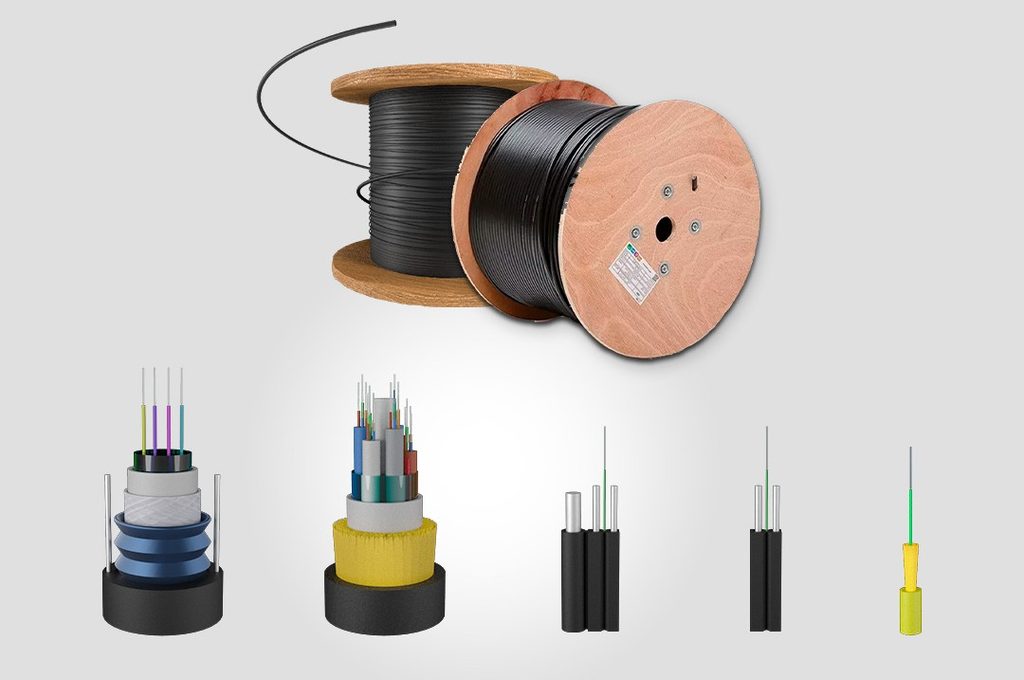
Fiber optic cable types fall into two main groups, single-mode and multimode. Each group is then built as an indoor, outdoor, or FTTH cable, depending on where it runs. Use single-mode OS2 fiber for long or outdoor links. Use multimode OM3 or OM4 for short links inside buildings and data centers. Use bend-insensitive G.657 drop cable for the last stretch to a home.
This guide explains the different types of fiber cables, how to tell fiber cable types apart, and how to choose among the types of fiber optic cables by distance, environment, and fire code. Installers, IT managers, ISP planners, and buyers can use the decision table in the “Which Fiber Optic Cable Is Best?” section.
Quick Summary
- Two main types: Fiber optic cable comes in two types by light mode, single-mode (about 9 µm core) and multimode (50 or 62.5 µm core).
- Distance decides the mode: Single-mode fits long distances. Multimode fits short links, such as 300 to 400 m at 10 Gbps on OM3 and OM4.
- Environment decides the construction: Indoor cables use tight-buffered, flame-retardant designs. Outdoor cables use water-blocked loose-tube designs with PE or armored jackets.
- FTTH drops need bend-insensitive fiber: Drop cables use G.657.A1 or A2 single-mode fiber for tight corners.
- Connectors are a separate choice: LC suits dense data centers. SC/APC suits FTTH.
- Best choice: For new projects, OS2 single-mode is usually the safest long-term pick. Choose OM4 only when the link is short and the equipment is multimode.
What Are the Main Types of Fiber Optic Cable?
The two main types of fiber optic cable are single-mode fiber (SMF) and multimode fiber (MMF). The Fiber Optic Association (FOA) confirms that these are the two fiber types in common use, and both have a 125 µm cladding diameter (FOA).
How Many Types of Fiber Optic Cable Are There?
The answer depends on the sorting method:
| Sorting Method | Types | Question It Answers |
|---|---|---|
| Fiber mode | Single-mode, multimode (plus rare plastic optical fiber, POF) | How far and how fast? |
| Construction | Tight-buffer, loose-tube, ribbon, breakout, armored | How rugged? |
| Environment | Indoor, outdoor, indoor/outdoor, FTTH drop | Where is the cable installed? |
| Fiber count | Simplex, duplex, multi-fiber | How many links? |
| Fire rating | OFNP, OFNR, LSZH | Which building code applies? |
The three types of fiber optic cable that many guides list are single-mode, multimode, and POF. POF is rare in telecom and mostly serves very short links.
Cable, patch cord, and connector are different things. A cable is the bulk product. A patch cord is a cable with factory-fitted connectors. Connector and polish type are chosen separately (see the connector section below).
How Do Single-Mode and Multimode Fiber Differ?
Single-mode fiber has a small core and carries one light path over long distances. Multimode fiber has a larger core and carries many light paths over short distances. This is also the quickest way to tell the difference between single-mode and multimode fiber.
| Feature | Single-Mode (OS1/OS2) | Multimode (OM1–OM5) |
|---|---|---|
| Core size | About 9 µm | 62.5 µm (OM1) or 50 µm (OM2–OM5) |
| Light source | Laser | LED (OM1) or VCSEL (OM2–OM5) |
| Typical reach | Kilometers | Up to a few hundred meters |
| Jacket color | Yellow | Orange, aqua, or lime green |
| Cable cost | Lower | Higher per meter |
| Optics cost | Higher | Lower |
| Best for | Outdoor, campus, carrier, FTTH | Data centers, in-building links |
How to Tell the Difference Between Single-Mode and Multimode Fiber
- Read the jacket print. “9/125” means single-mode. “50/125” or “62.5/125” means multimode.
- Check the jacket color. Yellow usually means single-mode. Orange, aqua, or lime green usually means multimode.
- Check the transceiver label. 10GBASE-LR is single-mode. 10GBASE-SR is multimode.
Jacket color is a convention, not a guarantee. Always confirm the printed core size.
What Are the Types of Single-Mode Fiber Optic Cable?
Single-mode fiber optic cable types are mainly OS1 and OS2, and OS2 suits most modern projects.
| Type | Construction | Max Attenuation | Typical Use |
|---|---|---|---|
| OS1 | Tight buffer | 1.0 dB/km | Indoor, shorter links, legacy plant |
| OS2 | Loose tube | 0.4 dB/km | Outdoor, long-haul, FTTH backbone |
Single-mode fiber follows ITU-T G.652, and bend-insensitive grades follow ITU-T G.657 (ITU-T G.652, ITU-T G.657). OS1 and OS2 attenuation figures come from ISO/IEC 11801 cabling classes.
What Are the Types of Multimode Fiber Optic Cable?
Multimode fiber optic cable types are OM1, OM2, OM3, OM4, and OM5. OM1 is mostly obsolete. OM3 and OM4 dominate new in-building installs. These are the “fiber optic cable types OM1, OM2, OM3” that spec sheets list.
| Type | Core | Jacket Color | Bandwidth at 850 nm | 10G Reach | 40G / 100G Reach |
|---|---|---|---|---|---|
| OM1 | 62.5 µm | Orange | 200 MHz·km | 33 m | Not supported |
| OM2 | 50 µm | Orange | 500 MHz·km | 82 m | Not supported |
| OM3 | 50 µm | Aqua | 2,000 MHz·km | 300 m | 100 m / 70 m |
| OM4 | 50 µm | Aqua (some brands use violet) | 4,700 MHz·km | 400 m | 150 m / 100 m |
| OM5 | 50 µm | Lime green | 4,700 MHz·km, plus 2,470 at 953 nm | 400 m | 150 m / 100 m (SR4) |
Reach values follow IEEE 802.3 for 10GBASE-SR, 40GBASE-SR4, and 100GBASE-SR4. Short-reach 400G optics typically reach about 100 m on OM4. Always confirm with the transceiver datasheet.

What Are the Different Types of Fiber Optic Cable Cores?
Fiber optic cable core types are 9 µm (single-mode), 50 µm (modern multimode), and 62.5 µm (older multimode). The core is the glass center that carries light. Modern multimode fiber is graded-index, which reduces signal spreading (FOA).
“Core count” means something else. A “12-core cable” holds 12 separate fibers under one jacket.
What Is the Color Code for Fiber Optic Cable Types?
Two color systems exist:
- Jacket color shows fiber type: yellow (OS2), orange (OM1/OM2), aqua (OM3/OM4), lime green (OM5).
- Strand color identifies fibers inside a multi-fiber cable. TIA-598 sets 12 colors in order: blue, orange, green, brown, slate, white, red, black, yellow, violet, rose, aqua.
A color code chart helps most when splicing, because installers match tube colors and then fiber colors in order.
What Is Multimode Fiber Used For?
Multimode fiber is used for short links inside buildings, campuses, and data centers. Typical uses include server-to-switch links, storage networks, and building risers under about 400 m. Multimode transceivers cost less than single-mode transceivers, which is why many data centers still use OM4 for short runs.
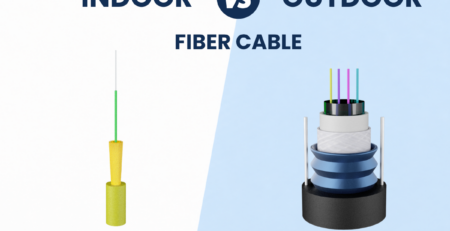
What Are the Indoor Fiber Optic Cable Types?
Indoor fiber optic cable types use tight-buffered fibers and fire-rated jackets. Tight-buffer cables are flexible and easy to terminate, so they suit indoor use (FOA).
Common indoor cable types:
- Simplex and zipcord (duplex): One or two fibers. Used for patch cords and short links.
- Distribution cable: Several tight-buffered fibers under one jacket with aramid yarn (Kevlar) strength members. FOA calls it the most popular indoor cable.
- Breakout cable: Each fiber has its own sub-jacket. It is tougher and can be terminated directly, but it is thicker.
- Indoor/outdoor cable: A PE outer jacket that can be stripped to expose a flame-retardant inner jacket.
Which Jacket Rating Is Right: OFNP, OFNR, or LSZH?
| Rating | Test Standard | Typical Location | Trade-off |
|---|---|---|---|
| OFNP (plenum) | UL 910 | Air-handling spaces, above ceilings | Fluoropolymer jacket, highest cost |
| OFNR (riser) | UL 1666 | Vertical shafts between floors | PVC jacket releases halogen gases when burned |
| LSZH | IEC 60754, IEC 61034 | Transit, hospitals, schools, confined spaces | Low smoke, no halogen acid gas |
Fire ratings matter. In the U.S., the National Electrical Code (NEC) uses ratings such as OFNP (plenum), OFNR (riser), and OFNG (general use). Many other regions prefer LSZH (low smoke, zero halogen) jackets. Local code decides which rating you need, so check NFPA 70 or your local authority.
Should You Choose Simplex or Duplex Fiber?
Choose duplex for standard transceivers and simplex for BiDi optics.
| Type | Fibers | Best For |
|---|---|---|
| Simplex | 1 | BiDi optics, CCTV links, sensors |
| Duplex | 2 | SFP+/SFP28 switch links, data center interconnects |
| Multi-fiber (MPO) | 8–24+ | Parallel optics such as 40G/100G SR4 |
Hypothetical example: A 10-story office needs 10G links between a basement server room and floor closets. Each run is under 150 m. Riser-rated, 12-fiber OM4 distribution cable fits, because the distance is short and multimode optics cost less.
What Are the Outdoor Fiber Optic Cable Types?
Outdoor fiber optic cable types use loose-tube construction with water blocking and UV-resistant PE jackets. Loose-tube and ribbon cables give more weather sealing and pulling strength than tight-buffer cables (FOA).
What Are the Types of Underground Fiber Optic Cable?
| Type | Construction | Best For |
|---|---|---|
| Duct cable | Loose tube, gel or dry water blocking, PE jacket | Conduit or HDPE duct |
| Direct-buried cable | Steel tape or wire armor, or rodent-resistant glass yarn | Trenching without conduit |
| Microduct/blown cable | Small, light cable blown into microducts | Fast urban builds |
Armor adds crush and rodent protection but makes the cable heavier and less flexible. Armor is only needed for direct burial or high-risk routes.
What Are the Types of Aerial Fiber Optic Cable?
- ADSS (all-dielectric self-supporting): No metal parts, so safe near power lines.
- Figure-8 cable: Fiber unit attached to a steel messenger wire that carries tension.
- Lashed cable: Standard cable lashed to a separate steel strand.
Select aerial cable from span, ice, and wind calculations, not from a catalog default. For loose-tube versus tight-buffer trade-offs, read Loose Tube vs. Tight Buffered Fiber Optic Cable.
Which Outdoor Fiber Optic Cable Types Are Best?
Most outdoor networks use OS2 single-mode. The loss is low, and the reach covers campus, metro, and rural routes.
Which Fiber Optic Cable Types Work for FTTH?
FTTH networks use G.652.D single-mode fiber in feeder and distribution cables, and bend-insensitive G.657.A1 or A2 fiber in drop cables. A drop cable is the last segment, running from a distribution point to the home. G.657 fiber stays compatible with G.652.D plant but tolerates tight bends around corners and staples (ITU-T G.657).
| FTTH Cable | Fibers | Where Used | Note |
|---|---|---|---|
| Flat drop (indoor) | 1–4 | Walls, baseboards | Low profile, less crush resistance |
| Round drop | 1–4 | Duct, conduit | Better mechanical strength |
| Figure-8 drop | 1–4 | Pole to house | Messenger wire carries load |
| ADSS or distribution | 12–96+ | Pole-to-pole feeder | Self-supporting, no metal |
Step-by-step FTTH cable selection:
- Step 1: Identify the route (aerial, duct, direct burial, indoor).
- Step 2: Pick the shape: figure-8 for aerial, round for duct, flat for indoor.
- Step 3: Specify G.657.A2 fiber if the route has tight corners.
- Step 4: Choose an LSZH jacket for indoor sections where code requires it.
- Step 5: Check tensile rating against span length.
Standard drop cable is usually not rated for direct burial. Use duct or an armored version.
Which Fiber Optic Cable Is Best?
No single fiber optic cable is best for every job, but OS2 single-mode is the best default for new long-term builds. Single-mode fiber supports distances from meters to tens of kilometers and can be upgraded by changing only the optics.
How to Choose Among Fiber Optic Cable Types
- Measure link length. Over about 400 m, choose single-mode.
- Match the equipment. SR optics need multimode. LR optics need single-mode.
- Define the environment. Indoor, outdoor, underground, aerial, or FTTH drop.
- Check the fire rating. OFNP, OFNR, or LSZH, based on local code.
- Choose fiber count. Add 20–30% spare fibers for growth.
- Pick connectors. Match connector and polish to the equipment.
- Run a link loss budget. Add fiber, connector, and splice losses, then compare with the transceiver’s power budget.
Decision Table
| Your Situation | Recommended Cable |
|---|---|
| Data center, under 100 m, 40G/100G | OM4 or OM5 multimode |
| Building riser, 10G, under 300 m | OM3 or OM4 multimode, riser-rated |
| Campus link between buildings | OS2 loose-tube, armored if buried |
| Pole route near power lines | OS2 ADSS |
| FTTH home connection | G.657.A2 drop cable |
| Harsh industrial route | Armored or industrial-grade OS2 |
| Unsure, building for 15+ years | OS2 single-mode |
Which Connector and Polish Should Match the Cable?
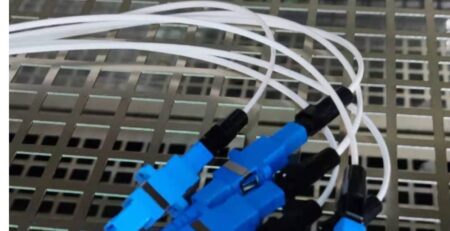
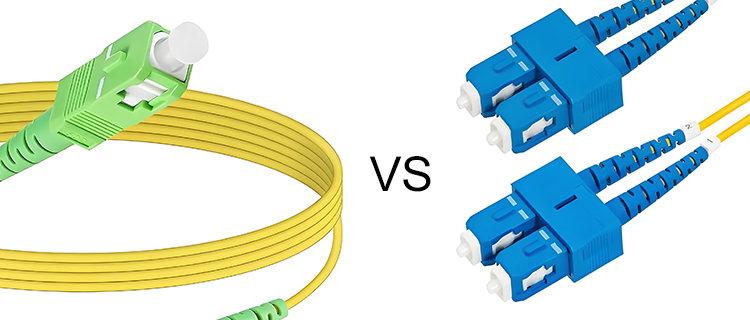
LC and SC are connector types, not cable types, and the main difference is size. LC has a 1.25 mm ferrule. SC has a 2.5 mm ferrule.
| Feature | LC | SC |
|---|---|---|
| Ferrule | 1.25 mm | 2.5 mm |
| Size | Small | About twice as large |
| Latch | Clip | Push-pull |
| Common use | Data centers, SFP modules | FTTH, telecom |
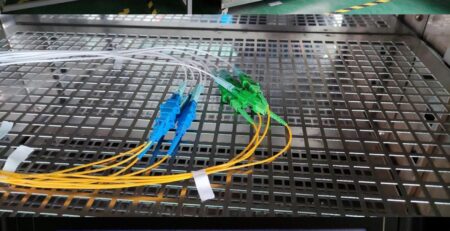
Either connector works on single-mode or multimode cable. FTTH networks often use SC/APC, where the green body marks the angled polish. ST (bayonet) and MT-RJ remain in legacy systems. CS, SN, and MDC are newer small duplex connectors for 400G/800G. MPO/MTP is the multi-fiber connector for parallel optics.
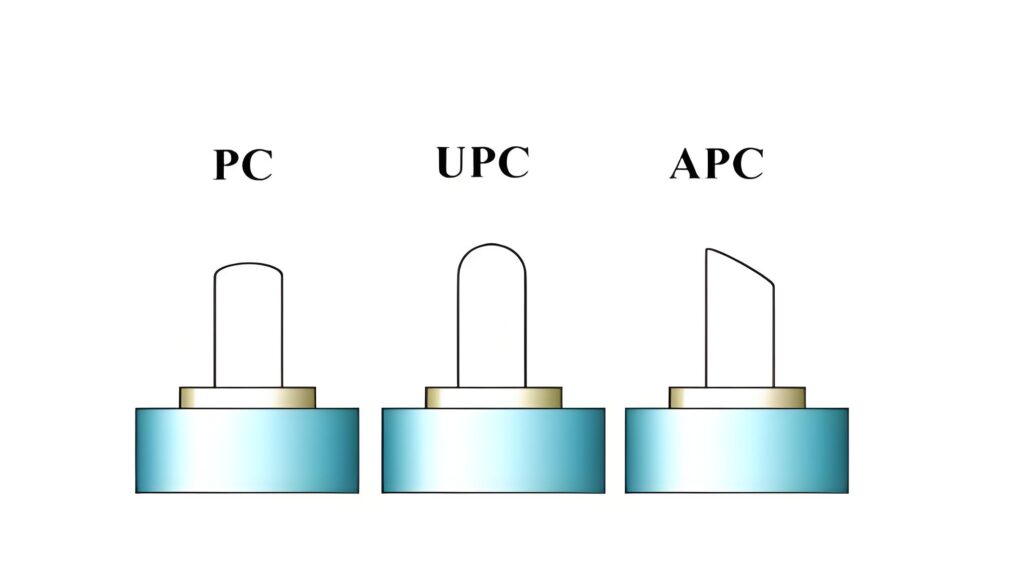
UPC vs. APC: The polish type controls reflection.
| Polish | End-Face | Typical Return Loss | Use |
|---|---|---|---|
| UPC | Domed | About 50 dB or better | Digital LAN, data centers, multimode |
| APC | 8° angle | About 60 dB or better | GPON/EPON FTTH, RF video, analog |
Never mate APC with UPC. The mismatch raises loss and can damage end faces.
When Are Specialty Fiber Optic Cables Needed?
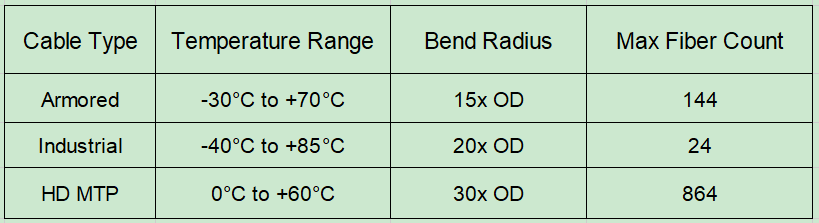
Specialty cables fit routes where standard cable fails. Ask suppliers for test data, not just claims.
| Type | Key Features | Typical Use | Check Before Buying |
|---|---|---|---|
| Armored | Steel tape or glass yarn layer | Rodent areas, direct burial | Crush and tensile test results |
| Industrial-grade | Oil-resistant jacket, wide temperature range | Factory automation, rail, wind farms | Datasheet temperature range |
| High-density | MPO trunks, small-diameter cable | Data center trays | Polarity and bend radius |
| FTTA | UV-stable, water-blocked jacket | Antenna-to-radio links | Outdoor ratings |
| Polarization-maintaining | Controlled polarization | Sensors, gyroscopes, quantum links | Connector key alignment |
Mechanical test methods are in the IEC 60794 series.
FAQ: Fiber Optic Cable Types
What are the types of fiber optic cable?
Fiber optic cable comes in two types by light mode: single-mode and multimode. By environment, cables are indoor, outdoor, or FTTH drop. By construction, they are tight-buffer, loose-tube, ribbon, breakout, or armored. A third mode type, plastic optical fiber, serves very short links.
What are the three types of fiber optic cable?
The three types are single-mode, multimode, and plastic optical fiber (POF). Single-mode suits long-haul and FTTH. Multimode suits buildings and data centers. POF has a large plastic core and serves short, low-cost links.
Which fiber optic cable is best?
OS2 single-mode is best for most new projects. It supports long distances and later speed upgrades without re-cabling. Choose OM4 multimode only for short in-building links where multimode optics cost less.
What is the difference between OS1 and OS2?
OS1 is tight-buffered indoor single-mode fiber with up to 1.0 dB/km attenuation. OS2 is loose-tube outdoor single-mode fiber with up to 0.4 dB/km. OS2 reaches farther and is standard for new installations.
Can outdoor cable be used indoors?
Usually not directly. Outdoor PE jackets are not flame-retardant, and codes limit how far they may enter a building. Use indoor/outdoor-rated cable, or transition to riser or LSZH cable shortly after the entrance.
What is the main difference between LC and SC fiber optic cables?
LC and SC are connectors, not cables. LC has a 1.25 mm ferrule and suits dense data center patching. SC has a 2.5 mm ferrule and push-pull body, and is common in FTTH. Both work on single-mode or multimode cable.
Need Fiber Optic Cable? Contact Deepblue Telecom
Deepblue Telecom is a fiber optic manufacturer and supplier based in Nanjing, China. Our range includes fiber optic cable, patch cords and pigtails, PLC splitters, and data cneter product solutions.
Request a quote: Email inquire@ftths.com or call +86 (025) 58098253. Send your route type, fiber count, jacket requirement, and quantity. Our team will recommend a matching cable.
Sources: FOA: Fiber Types · FOA: Fiber Optic Cable · FOA: Outside Plant Cable · ITU-T G.652 · ITU-T G.657 · IEEE 802.3 · NFPA 70 (NEC)